

TRT for Men in Chicago
Physician-Supervised. Lab-Based Protocols. Downtown Chicago.
Testosterone replacement therapy (TRT) for men at XSculpt is a physician-supervised, lab-based program that restores testosterone to a healthy range in men with clinically low T. If fatigue, brain fog, and declining gym performance have you questioning whether something is off, it probably is. You are not imagining it.
You Train Hard. You Eat Right. Something Still Feels Off.
The alarm goes off at 5 AM. You used to hit the gym before work without thinking about it. Now the snooze button wins three rounds before your feet hit the floor.
Your lifts have stalled. Body fat keeps climbing despite a clean diet and consistent programming. Focus drifts during meetings. You snap at your kids over nothing.
Libido went from something you never thought about to something you notice is missing.
That is not a discipline problem. It is not a willpower issue. And it is not something you should write off as stress, age, or needing a new supplement stack.
Most men sit with these symptoms for months, sometimes years, before getting a lab panel. When they do, the answer is often straightforward: testosterone has dropped below the range where your body functions the way you expect it to.
That is not a character flaw. It is a measurable, treatable condition. Learn more about low testosterone and its symptoms.

“I compete in Jiu Jitsu and I was looking for that extra push but I couldn’t find myself with energy to shed LBS. We did tests (bloodwork) first to see why my energy was down and I can say this now but WOW I had the testosterone level of an 80 year old. No wonder I didn’t feel like me.”
XSculpt TRT patient (Google review)
What Is TRT for Men?
TRT is a physician-supervised medical treatment that restores testosterone to a healthy, lab-verified range in men with clinically low levels.
Testosterone is the primary male sex hormone. It regulates muscle mass, bone density, red blood cell production, fat distribution, libido, and mood. Production peaks in your late teens and begins declining around age 30 at roughly 1-2% per year (Harman et al., Journal of Clinical Endocrinology & Metabolism, 2001).
Low testosterone (hypogonadism) is diagnosed when total testosterone drops below 300 ng/dL on a morning blood draw. But symptoms typically appear before the number gets that low. Many men feel the effects at 350-400 ng/dL, depending on their individual baseline.
TRT does not mean “steroids.” It means restoring your hormone level to where your body functioned well, under medical oversight, with dosing calibrated to your labs.
XSculpt uses injectable testosterone cypionate as the primary protocol. Dosing is adjusted every 8-12 weeks based on follow-up bloodwork. For more on how to inject testosterone, XSculpt provides detailed instruction during your first visit.
Key Terms at a Glance
| Term | Plain-English Definition |
|---|---|
| Hypogonadism | Clinically low testosterone, confirmed by bloodwork |
| Testosterone cypionate | The injectable form of testosterone used in most TRT protocols |
| Hematocrit | A measure of red blood cell concentration, monitored during TRT |
| SHBG | Sex hormone-binding globulin; affects how much testosterone your body can actually use |
| Aromatase | The enzyme that converts testosterone to estrogen |
What TRT Does Not Do
TRT is not a fitness shortcut. It will not replace training, nutrition, or sleep. What it does is restore the hormonal foundation that makes those inputs effective again. If your testosterone is already in a healthy range, TRT is not appropriate.
What Are the Benefits of TRT for Men?
Low testosterone costs you in ways that compound quietly. The gym sessions that used to build muscle now barely maintain it. The mental sharpness you relied on at work fades into a fog you cannot push through. The energy that carried you through a full day with your family is gone before dinner.
TRT does not add something foreign. It restores what your body used to produce on its own, so those inputs start working for you again.
| Benefit | What the Evidence Shows | Honest Caveat |
|---|---|---|
| Energy and fatigue | Reduced fatigue and improved daily energy levels (Snyder et al., NEJM, 2016; Testosterone Trials) | Effects build over 3-6 weeks. Not a stimulant. |
| Muscle mass and strength | 10-15% increase in lean muscle mass within 6 months when combined with resistance training (Bhasin et al., NEJM, 1996) | TRT alone, without training, produces modest gains. |
| Body fat reduction | Decrease in total body fat percentage, particularly visceral fat (Corona et al., European Journal of Endocrinology, 2016; meta-analysis) | Diet and exercise still required. TRT shifts the ratio, not the lifestyle. |
| Libido and sexual function | Improved libido, erectile quality, and sexual satisfaction (Snyder et al., NEJM, 2016; Sexual Function Trial) | Men with ED from non-hormonal causes (vascular, neurological) may see limited improvement. |
| Mood and emotional stability | Reduction in depressive symptoms and irritability (Walther et al., JAMA Psychiatry, 2019; meta-analysis) | TRT is not an antidepressant. Men with clinical depression should maintain their treatment plan. |
| Mental clarity | Improved focus, concentration, and reduction in “brain fog” (Resnick et al., Neurology, 2017; TTrials Cognition Trial) | Cognitive benefits are most noticeable in men with levels below 300 ng/dL. |
| Bone density | Increased bone mineral density, particularly in the spine and hip (Snyder et al., JAMA Internal Medicine, 2017; Bone Trial) | Meaningful improvement requires 12+ months of consistent treatment. |
What TRT Will Not Do
TRT will not produce supraphysiological results. It returns your testosterone to a normal range, not above it. It will not reverse aging, cure diseases, or replace treatment for conditions that happen to overlap with low-T symptoms.
The first step is a blood panel, not a commitment.
Is TRT Safe? Side Effects, Risks, and Monitoring
TRT is safe when prescribed by a physician, dosed based on lab results, and monitored with regular bloodwork. The risks are real, known, and manageable.
This section is here, near the top of the page, because safety is the number one concern men research before starting TRT. Your questions about cardiovascular risk, testicular changes, and fertility are valid. Every one of them has a clinical answer, and a board-certified medical team manages each one through protocol, not guesswork.
- Cardiovascular risk. The FDA issued a warning in 2014 about potential cardiovascular risks. A large 2024 randomized trial (TRAVERSE, 5,204 men, median follow-up 33 months) found that testosterone gel was not associated with increased major adverse cardiac events compared to placebo (Lincoff et al., New England Journal of Medicine, 2023). Monitoring hematocrit (red blood cell concentration) and managing cardiovascular risk factors are standard protocol.
- Polycythemia (elevated red blood cells). The most common lab-detectable side effect. Hematocrit levels above 54% require dose adjustment or therapeutic phlebotomy. XSculpt monitors this at every follow-up lab draw.
- Testicular atrophy. Affects approximately 30% of men on TRT (Kohn et al., Translational Andrology and Urology, 2016). When external testosterone is supplied, the body reduces its own production, which can reduce testicular size. This is a known, expected effect, not a complication. HCG (human chorionic gonadotropin) co-therapy can prevent or reverse it. XSculpt discusses HCG options during initial evaluation.
- Fertility impact. TRT suppresses sperm production in most men. This is reversible: sperm production typically returns to baseline within 6-12 months of stopping TRT (Patel et al., World Journal of Men’s Health, 2019). Men who are planning to have children should discuss this at consultation. HCG co-therapy may preserve fertility during treatment.
- Acne and oily skin. Some men experience increased acne, particularly in the first 3-6 months. Typically manageable and dose-dependent.
- Mood changes. Rare. Some men report irritability or mood swings during dose adjustments. Stable dosing with consistent lab monitoring reduces this.
What XSculpt Monitors
Every TRT patient at XSculpt receives regular bloodwork to track:
- Total and free testosterone
- Hematocrit and hemoglobin
- PSA (prostate-specific antigen)
- Estradiol
- Lipid panel
- Liver function
Dose adjustments happen based on lab values, not symptoms alone.
Every risk has a protocol. Every protocol starts with your labs.
How Much Does TRT Cost in Chicago?
XSculpt TRT programs start at $550 for a 3-month protocol and $995 for a 6-month protocol. These prices cover physician visits and testosterone medication.
| Program | Price | Includes |
|---|---|---|
| 3-month TRT protocol | $550 | Physician consults, testosterone medication, dosing protocol |
| 6-month TRT protocol | $995 | Physician consults, testosterone medication, dosing protocol |
| Initial lab panel | Additional | Full hormone panel + metabolic markers |
| Vitamin optimization (if recommended) | Additional | Based on lab findings |
For $550 over three months, the program includes physician consultations, testosterone medication, and a dosing protocol calibrated to your labs.
Consider that against what low T is already costing: the gym sessions that produce nothing, the focus you cannot hold at work, the evenings spent on the couch instead of with your family.
Pricing is transparent. The numbers above are what you pay. Lab costs depend on what your panel requires and whether your insurance covers diagnostic bloodwork.
Many men start with the 3-month protocol to confirm they respond well, then move to the 6-month program for better per-month value.
Financing options available for patients who prefer monthly payments.
Pricing is subject to change. Contact XSculpt to confirm current rates.
Your physician consultation and analysis are complimentary. Lab work is $250.
Who Is a Candidate for TRT?
You may be a candidate for TRT if you have symptoms of low testosterone and a blood test confirms your levels are below the clinical threshold.
Your testosterone was there once. It supported the energy, the focus, the recovery, the drive. TRT does not introduce something new into your system. It restores what your body produced on its own before levels declined.
Candidacy Checklist
- Persistent fatigue that does not resolve with sleep or rest
- Decreased muscle mass or strength despite consistent training
- Increased body fat, particularly abdominal, despite diet adherence
- Reduced libido or erectile difficulty
- Brain fog, poor concentration, or memory complaints
- Irritability, low mood, or emotional flatness
- Morning total testosterone below 300 ng/dL (confirmed on at least one blood draw)
Who Is Not a Good Candidate
- Men with testosterone levels in the normal range (TRT is not performance enhancement)
- Men with untreated prostate cancer or breast cancer
- Men with uncontrolled polycythemia (elevated red blood cell count)
- Men actively trying to conceive without a fertility-preservation plan
- Men whose symptoms are better explained by another condition (sleep apnea, thyroid disorder, clinical depression)
A lab panel is the starting point. XSculpt does not prescribe TRT based on symptoms alone.
“Recently started testosterone pellets here and can’t say enough good things! I initially wasn’t too sure if this would be the best option for me and skeptical about side effects. They each consulted with me and explained the benefits as well as results of my blood tests. I have felt a significant improvement in my energy and overall well being.”
Ari D, XSculpt patient (Google review, 5 stars)
What to Expect: Labs, Protocol, and Follow-Up at XSculpt
The XSculpt TRT protocol starts with a blood draw and ends with ongoing, lab-driven monitoring. Every dosing decision is anchored to your numbers, not a one-size-fits-all template.
Energy shifts within weeks, not months. Most men notice improved sleep and morning energy before the first follow-up lab. Body composition and strength changes build over 3-6 months as the protocol stabilizes.
This is what separates XSculpt TRT from online clinics that ship testosterone without ongoing lab oversight.
TRT Delivery Methods: How Testosterone Is Administered
| Method | How It Works | Pros | Cons |
|---|---|---|---|
| Injections (cypionate) | Self-administered intramuscular or subcutaneous, 1-2x/week | Most consistent levels, best dose control, lowest cost | Requires needle comfort |
| Topical gel/cream | Applied daily to skin (shoulders, arms) | No needles | Transfer risk to partners/children, daily application, inconsistent absorption |
| Pellets | Implanted subcutaneously every 3-6 months | Low maintenance | Surgical insertion, dose not easily adjustable, risk of extrusion |
| Nasal gel | Applied inside the nostrils 2-3x daily | No transfer risk | Multiple daily applications, limited data |
XSculpt primarily prescribes injectable testosterone cypionate because it offers the most consistent blood levels and the best dose control.
Most XSculpt patients use injections. The initial in-office training session covers technique, site rotation, and dose timing. Men who are uncomfortable with needles are counseled on topical alternatives and their trade-offs.
For a broader view of hormone replacement therapy options in Chicago, XSculpt covers the full spectrum of hormone optimization.
TRT and Gynecomastia: What Men Should Know
Testosterone and breast tissue are connected. Men starting TRT should understand how hormone changes can affect chest appearance, and why XSculpt is positioned to manage both.
When testosterone levels rise through TRT, the body converts some of that testosterone to estradiol (estrogen) via aromatase. In some men, this estrogen spike causes gynecomastia: breast tissue growth behind the nipple.
This is not a reason to avoid TRT. It is a reason to choose a practice that monitors estradiol levels and manages the full picture.
At XSculpt:
- Estradiol is tracked at every follow-up lab panel
- Aromatase inhibitors (anastrozole) are prescribed when estradiol rises above the target range
- If gynecomastia develops or pre-exists, XSculpt performs gynecomastia surgery in-house
- Men who came to XSculpt for gynecomastia surgery and also have low T can address both conditions with the same team
No other TRT clinic in Chicago offers this. Standalone hormone clinics refer out for surgery. Standalone surgical practices refer out for TRT. XSculpt handles both.
Learn more: What Is Gynecomastia? | Gynecomastia and Testosterone | Estrogen Blockers for Men
TRT Results: Timeline and What to Realistically Expect
TRT works gradually. The first changes most men notice are improved energy and mood, usually within 3-6 weeks. Body composition changes take longer.
| Timeframe | What to Expect |
|---|---|
| Weeks 2-4 | Improved energy, better sleep quality, early mood improvement |
| Weeks 4-8 | Increased libido, mental clarity, reduced brain fog |
| Months 2-4 | Improved gym recovery and strength, beginning of body composition shift |
| Months 4-6 | Noticeable reduction in body fat, increased lean muscle mass |
| Months 6-12 | Full optimization, stabilized mood and energy, bone density improvements begin |
“I am also doing TRT treatments now also a recommended by Marc and I feel fantastic! I wish I had started this sooner.”
Jeff, XSculpt patient (Google review, 5 stars)
The early wins come fast. Energy and sleep quality shift in the first few weeks. The full benefit builds gradually over 6-12 months, and each follow-up lab panel confirms the progress in numbers, not just how you feel.
Results vary by individual. Men with severely low testosterone (below 200 ng/dL) may see faster initial improvement. Men closer to the borderline range (250-350 ng/dL) may experience subtler changes.
Consistency matters: missed doses and irregular follow-up slow progress.
Individual results may vary. TRT outcomes depend on baseline testosterone level, adherence to the protocol, and overall health.
What Men Say About Starting TRT
These are real XSculpt patients. Their words, verbatim, from Google reviews.
These men spent months, sometimes years, writing off their symptoms before a lab panel gave them an answer. Their stories are not unusual. They are the common pattern.
Individual results may vary.
These men started the same way: with a lab panel.
Why Choose XSculpt for TRT in Chicago?
XSculpt is not a telemedicine hormone mill. It is a physician-led men’s health practice that combines surgical body contouring with hormone optimization under one roof.
- Lab-first, always. No prescriptions without bloodwork. No cookie-cutter dosing.
- In-person physician care. Dr. Maria Osipova, MD, manages TRT clinically. Dr. Marc A. Adajar, MD, FACS, provides medical oversight. Board-certified physicians whose credentials you can verify, managing your protocol with lab data at every step.
- The only TRT + surgery practice in Chicago. If TRT causes or reveals gynecomastia, XSculpt corrects it surgically without a referral.
- Transparent pricing. $550 for 3 months. $995 for 6 months. No subscription traps, no hidden fees.
- Monitoring that continues. Regular labs, dose adjustments, and direct physician access for as long as you are on TRT.
- Men-only focus. XSculpt’s entire practice is built around male body contouring and men’s health. The waiting room, the clinical approach: designed for men.
See what lab-based TRT looks like at XSculpt.
Meet Your TRT Team at XSculpt
Dr. Maria Osipova, MD
Dr. Maria Osipova, MD, is a board-certified wellness physician with over 10 years of experience in hormone optimization, TRT, medical weight loss, and peptide therapy. She manages the clinical side of every XSculpt TRT patient: lab interpretation, dosing decisions, co-therapy protocols, and ongoing monitoring.
Meet Dr. Osipova
Dr. Marc A. Adajar, MD, FACS
Dr. Marc A. Adajar, MD, FACS, is a Fellow of the American College of Surgeons with over 20 years of surgical experience. As XSculpt’s lead surgeon and medical director, Dr. Adajar provides oversight for the TRT program and leads all surgical procedures, including gynecomastia correction for patients whose TRT intersects with chest concerns.
Meet Dr. Adajar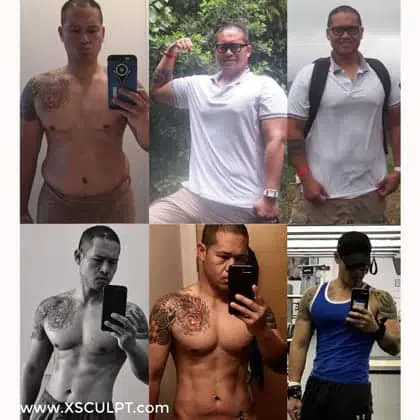
Frequently Asked Questions About TRT for Men
TRT stands for testosterone replacement therapy. It is a physician-supervised medical treatment that restores testosterone to a healthy, lab-verified range in men with clinically low levels. XSculpt TRT uses injectable testosterone cypionate with regular bloodwork monitoring.
Age is not the determining factor. Testosterone levels are. Men in their late 20s and 30s can have clinically low testosterone due to genetics, lifestyle factors, prior steroid use, or medical conditions. If your blood panel confirms low T and you have symptoms, you may be a candidate regardless of age.
It can. Testicular atrophy affects approximately 30% of men on TRT (Kohn et al., Translational Andrology and Urology, 2016). When external testosterone is supplied, the body reduces its own production, which can reduce testicular size. This does not affect libido or sexual performance.
HCG co-therapy can prevent or reverse the change. XSculpt discusses this at your initial evaluation.
This is one of the most common questions men ask before starting TRT. You are not the only one thinking about it.
Possibly. TRT is typically a long-term commitment. When external testosterone is provided, the body’s natural production decreases. Some men can taper off with medical supervision, but many choose to continue because the benefits depend on maintaining healthy testosterone levels.
Think of it like blood pressure medication: you take it because it works, and you stop when your doctor and your labs say you can.
The largest randomized trial to date (TRAVERSE, 5,204 men, 2023) found that testosterone gel was not associated with increased major adverse cardiac events compared to placebo (Lincoff et al., New England Journal of Medicine, 2023). Cardiovascular safety depends on proper monitoring: XSculpt tracks hematocrit, lipids, and blood pressure at every follow-up.
A morning blood draw measuring total testosterone is the standard diagnostic test. Levels below 300 ng/dL on two separate draws confirm hypogonadism. Many men feel symptoms at 300-400 ng/dL, depending on individual baseline.
XSculpt runs a full panel that includes free testosterone, SHBG, estradiol, and metabolic markers. You can also review XSculpt’s guide to testosterone FAQ for common diagnostic questions.
Most men who eventually start TRT spent months writing off their symptoms as stress or aging before a lab panel gave them a clear answer.
Energy and mood improvements typically appear within 3-6 weeks. Libido changes within 4-8 weeks. Body composition changes (muscle gain, fat loss) take 3-6 months of consistent treatment combined with training. Full optimization takes 6-12 months.
The most common side effects are acne, oily skin, and elevated hematocrit (red blood cell count). Testicular atrophy affects about 30% of men and is manageable with HCG co-therapy. Mood changes are rare and typically resolve with dose adjustments. All side effects are monitored through regular bloodwork at XSculpt.
Yes. TRT suppresses sperm production in most men. This is reversible: production typically returns within 6-12 months of stopping treatment (Patel et al., World Journal of Men’s Health, 2019). Men who are planning to start a family should discuss fertility preservation (including HCG co-therapy) with Dr. Osipova before beginning TRT.
XSculpt TRT starts at $550 for a 3-month program and $995 for a 6-month program. These prices include physician visits and medication. Your physician consultation and analysis are complimentary; lab work is $250. Pricing is subject to change. View financing options.
It can. When testosterone levels rise, some is converted to estrogen via aromatase. Elevated estrogen can cause breast tissue growth. XSculpt monitors estradiol at every lab panel and prescribes aromatase inhibitors when levels rise above the target range. If gynecomastia develops, XSculpt performs gynecomastia surgery in-house.
TRT restores testosterone to a normal, healthy range under physician supervision. Anabolic steroid use pushes testosterone far above physiological levels without medical oversight. XSculpt TRT is a medical treatment with dosing based on lab values and regular monitoring. It is not performance enhancement.
The initial evaluation and lab draw are in-person at XSculpt’s downtown Chicago office (310 W Superior St, Fl 2 Ste 201, Chicago, IL 60654). Most men self-administer injections at home after an in-office training session. Follow-up labs are drawn at a local lab or in-office. Virtual check-ins are available between lab appointments.
Over-the-counter testosterone boosters (tribulus, D-aspartic acid, fenugreek) have not been shown to raise testosterone to clinically meaningful levels in men with hypogonadism (Clemesha et al., World Journal of Men’s Health, 2020). If your testosterone is below 300 ng/dL, supplements are unlikely to resolve your symptoms. TRT is a medical intervention; boosters are not.
Your testosterone will return to its pre-treatment level, and symptoms will likely return. Natural production may take weeks to months to resume. Stopping should be done under physician guidance with a tapering protocol, not abruptly.
XSculpt is located in downtown Chicago at 310 W Superior St, Fl 2 Ste 201, Chicago, IL 60654.
Still have questions? A TRT evaluation answers them with your own lab data.
Alternatives to TRT: What Else Men Try
TRT is not the only option men consider. Here is how the most common alternatives compare.
| Alternative | What It Does | Limitation |
|---|---|---|
| Clomiphene (Clomid) | Stimulates the body’s own testosterone production | Effective for some men, but does not work for primary hypogonadism. Off-label use. |
| HCG monotherapy | Stimulates testicular testosterone production | May not achieve sufficient levels in men with very low T. |
| Lifestyle optimization (sleep, training, diet, stress) | Supports natural testosterone production | Important regardless, but rarely sufficient for men below 300 ng/dL. |
| Over-the-counter testosterone boosters | Various herbal supplements | No clinical evidence of raising testosterone to meaningful levels in hypogonadal men (Clemesha et al., World Journal of Men’s Health, 2020). |
XSculpt does not default to TRT. If your labs and symptoms suggest an alternative approach may work, Dr. Osipova will discuss it. TRT is recommended when the evidence supports it and alternatives are unlikely to achieve the clinical goal.
For men exploring natural approaches first, XSculpt has published a guide on 10 ways to increase testosterone naturally.
Not sure whether TRT or another approach is right for you? Your lab results will tell the story.
Book Your TRT Evaluation at XSculpt
Your first visit includes a review of your symptoms and health history with Dr. Osipova, a lab draw, and a clear recommendation based on your numbers. If TRT is right for you, you will leave with a protocol. If it is not, you will know why.
Either way, you will have an answer instead of a guess.
XSculpt | 310 W Superior St, Fl 2 Ste 201, Chicago, IL 60654 | (833) 972-8578