
Gynecomastia is excess breast gland tissue in men, and it progresses across four defined grades based on tissue volume and skin excess. Grade 1 is mild localized tissue around the areola. Grade 4 involves significant tissue growth with ptosis requiring more complex surgical correction. Your grade determines which technique is used, what your recovery looks like, and what your chest will look like afterward. Exercise and diet do not change your grade — because this is not fat.
Table of Contents
Key Takeaways
- Gynecomastia grades 1 through 4 are defined by the Simon Classification, which accounts for tissue volume (in grams) and skin excess
- All four grades involve glandular breast tissue, not fat — no amount of training removes it
- Grade determines surgical approach: Grade 1 typically requires excision alone; Grades 2b through 4 require excision plus liposuction and sometimes skin reduction
- Once glandular tissue becomes fibrotic (typically after 12-18 months), it is permanent regardless of grade
- Grades 1 and 2 are the most common presentations and are routinely treated as outpatient procedures with gym return in 4-6 weeks
What Is Gynecomastia, and Why Do Grades Matter?
Gynecomastia affects an estimated 32-65% of men at some point in their lives. It is one of the most common male conditions — and one of the least talked about.
The clinical cause is a hormonal imbalance between estrogen and testosterone that triggers breast gland development in the male chest. Puberty, aging, anabolic steroid use, certain medications, and underlying health conditions can all initiate it. The result is firm, glandular tissue that sits directly behind the areola and does not respond to diet or exercise.
What makes grading important is that not all gynecomastia looks or behaves the same. The volume of tissue, whether skin has stretched, and the degree of nipple descent all affect what surgical approach is needed and what results are achievable. A Grade 1 and a Grade 4 are both gynecomastia — but they require very different procedures.
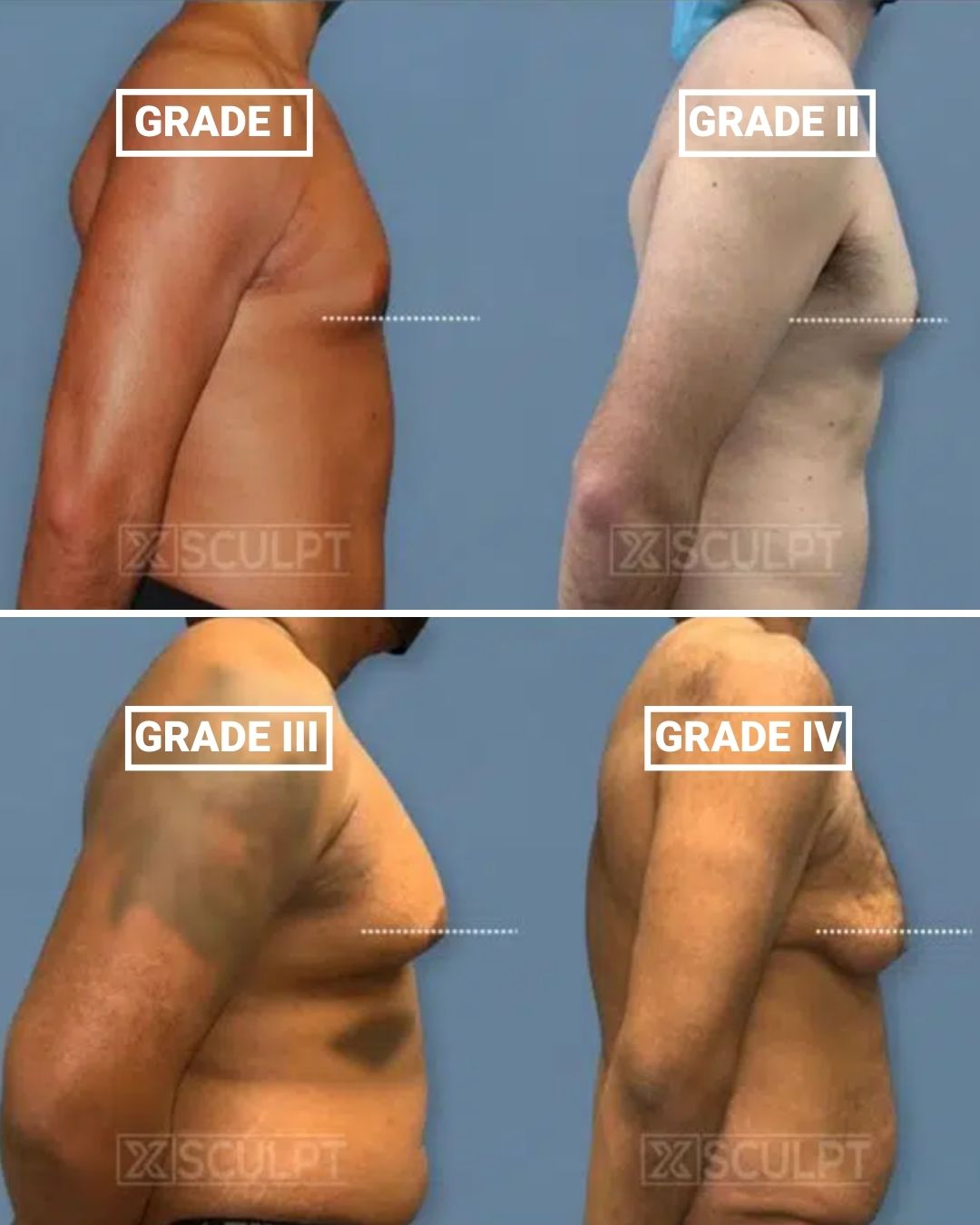
The Simon Classification: Grades 1 Through 4
The Simon Classification, established in 1973, remains the clinical standard for staging gynecomastia. It categorizes tissue volume and skin redundancy to guide surgical planning. Understanding where you fall on this scale is the first step toward knowing what treatment looks like.
Grade 1: Mild Enlargement, No Skin Excess
What it looks like: A small, firm button of glandular tissue centered behind the areola. The chest may appear slightly full or the nipple may protrude through shirts. No visible excess skin.
Tissue volume: Less than 250 grams per side.
Who has it: Many men with Grade 1 gynecomastia have dealt with nipple protrusion since adolescence and assumed it was chest fat. They’ve trained hard, kept their body fat low, and still couldn’t change the chest profile. The issue is not their training — it is glandular tissue sitting on top of muscle that no workout reaches.
Surgical approach: Gland excision alone, or excision with minimal liposuction for surrounding fatty tissue. The incision is hidden at the lower border of the areola. Outpatient procedure, typically 1-1.5 hours.
Results: Grade 1 before and after photos show a flat, natural chest contour with minimal visible scarring once healed. This is the most straightforward presentation to treat.
Grade 2a: Moderate Enlargement, No Skin Excess
What it looks like: More noticeable tissue growth extending slightly beyond the areola. The chest profile is visibly enlarged from the side and noticeably different when shirtless. Still no excess skin.
Tissue volume: 250 to 500 grams per side.
Who has it: Grade 2a is the most common presentation in men who consult at XSculpt. It is visible in fitted shirts, obvious when shirtless, and typically present since adolescence or early adulthood. Men with Grade 2a often describe wearing compression shirts daily and avoiding any situation that requires taking their shirt off.
Surgical approach: Gland excision combined with liposuction to contour the lateral chest wall and lower chest, creating a smooth transition to the natural pec line. This is the standard ChestSculpt procedure performed as an outpatient under sedation.
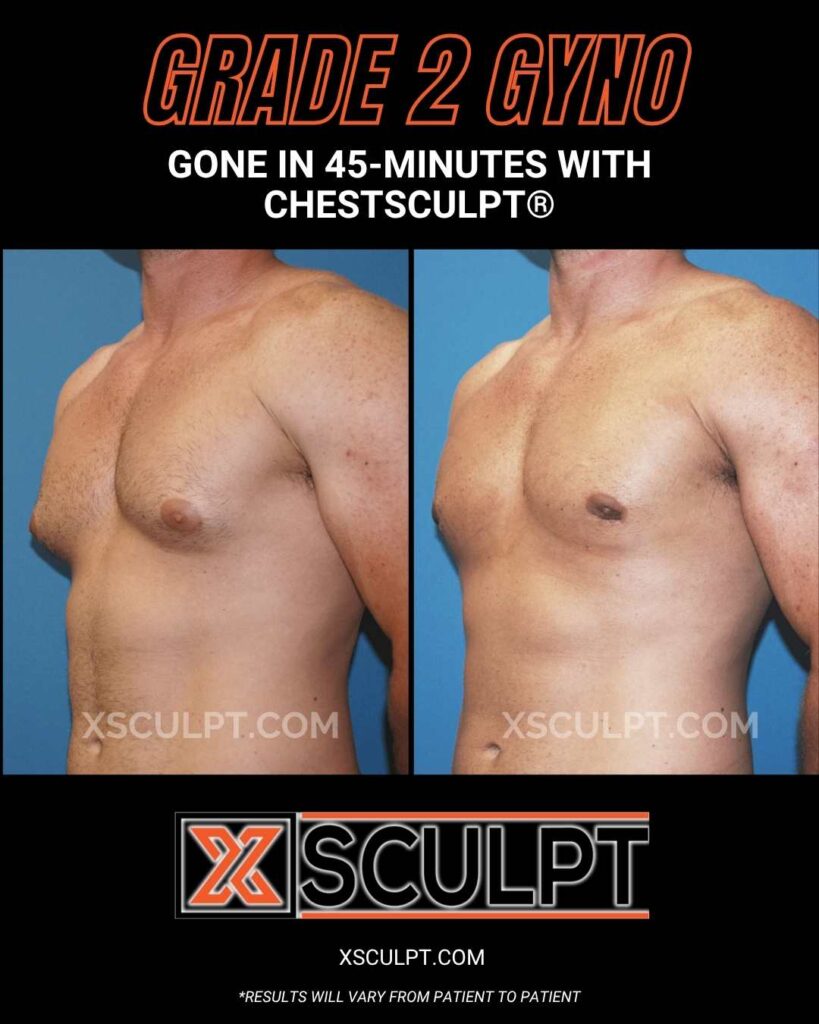
Results: Grade 2 before and after photos show the degree of visual change possible without visible scarring after healing.
Grade 2b: Moderate Enlargement with Minor Skin Excess
What it looks like: Similar tissue volume to Grade 2a, but the skin has stretched and does not retract fully. A mild ptosis (droop) may appear, particularly when leaning forward.
Tissue volume: 250 to 500 grams per side with skin redundancy.
Who has it: Grade 2b is more common in men who have had gynecomastia for many years, have experienced significant weight fluctuation, or developed a large tissue volume that stretched the overlying skin over time.
Surgical approach: Excision plus liposuction, with attention to skin retraction. In most Grade 2b cases, the skin contracts adequately after tissue removal. In some cases, adjunct skin-tightening with Renuvion (J-Plasma) may be recommended to optimize contour.
Clinical note: The distinction between 2a and 2b matters for expectation-setting. Men with Grade 2b should discuss skin retraction with their surgeon directly before surgery, which is why direct surgeon access during the consultation process is part of how ChestSculpt is structured.
Grade 3: Marked Enlargement with Moderate Skin Excess
What it looks like: Significant breast tissue growth that extends beyond the chest wall boundary. A more feminine chest profile. Visible skin excess at rest, with the nipple beginning to descend below the natural chest fold.
Tissue volume: More than 500 grams per side.
Who has it: Grade 3 is less common and typically seen in men who have had gynecomastia untreated for many years, men with significant weight alongside gynecomastia, or men with chronic conditions or medications driving persistent hormonal imbalance.
Surgical approach: Excision, liposuction, and skin reduction. Nipple and areola repositioning may be required to achieve a natural masculine chest contour. This is a more involved procedure with longer recovery and higher surgical complexity.
Results: Grade 3 before and after photos show the degree of correction achievable even in advanced presentations.
Grade 4: Severe Enlargement with Significant Ptosis
What it looks like: Marked tissue volume with significant skin excess and pronounced nipple descent. The chest resembles a female breast profile in both volume and shape.
Tissue volume: Often exceeding 750 to 1,000 grams per side in severe cases.
Who has it: Grade 4 is the least common presentation. It occurs most often in men with morbid obesity, hormonal disorders, long-term use of anabolic steroids or antipsychotic medications, or men who have had untreated gynecomastia for decades.
Surgical approach: Full male mastectomy with skin reduction, nipple repositioning, and liposuction. This procedure is closer in complexity to a breast reduction than a standard excision. Surgical planning is more detailed, and recovery is longer.
Results: Grade 4 before and after photos show comprehensive chest reconstruction including scar patterns across different techniques.
Grade Comparison at a Glance
| Grade | Tissue Volume | Skin Excess | Surgical Approach | Gym Return |
|---|---|---|---|---|
| 1 | <250g | None | Excision ± minimal lipo | 4-5 weeks |
| 2a | 250-500g | None | Excision + liposuction | 5-6 weeks |
| 2b | 250-500g | Minor | Excision + lipo ± skin tightening | 6 weeks |
| 3 | >500g | Moderate | Excision + lipo + skin reduction | 6-8 weeks |
| 4 | >750g | Significant | Full mastectomy + skin reduction + nipple repositioning | 8-10 weeks |
What Most Articles Get Wrong About Gynecomastia Grades
Most online content treats gynecomastia grades as purely visual categories. What they miss is the clinical implication of fibrous tissue maturation.
When gynecomastia first develops, especially during puberty, the glandular tissue is soft and hormonally responsive. During this early window (roughly the first 12-18 months), the condition can occasionally resolve on its own, particularly in adolescents. Teenage gynecomastia warrants a watchful waiting period for this reason.
After that window, the tissue becomes fibrotic and dense. It will not shrink with weight loss, hormone treatment, or any non-surgical approach. The tissue type has changed permanently.
This means grade is less about age than about duration. A 22-year-old with Grade 2a gynecomastia that has been present since age 15 has the same surgical need as a 40-year-old with the same presentation. The tissue is fibrotic in both cases. The younger patient may have more elastic skin and faster healing, but the surgical rationale is identical.
If the condition has been present for more than two years and shows no signs of regression, it is permanent.
How to Identify Your Grade Before a Consultation
You cannot definitively grade your own gynecomastia. Grade requires physical palpation and clinical assessment. But you can identify key indicators:
- Firmness: Is the tissue behind your nipple firm and clearly distinct from the surrounding chest? That points to glandular tissue, not fat. Pseudogynecomastia (chest fat without gland involvement) is soft and broadly distributed.
- Skin behavior: When you lean forward, does the chest tissue hang and create a fold? That suggests Grade 2b or higher.
- Symmetry: Many men have asymmetric gynecomastia — one side may be Grade 1 while the other is Grade 2. This is common and addressed during surgery.
- Duration: Present for more than two years? The tissue is almost certainly fibrotic and will not resolve on its own.
The fastest way to know your grade is a complimentary consultation with one of our surgeons. Most men can get meaningful initial clarity through a free virtual consultation before committing to an in-person visit.
Frequently Asked Questions
What grade of gynecomastia do most men have?
Most men who seek consultation have Grade 1 or Grade 2a. These are the most common presentations and the most straightforward to treat.
Can Grade 1 gynecomastia go away on its own?
Possibly, if it developed within the last 12-18 months and the tissue is still soft. Once the tissue becomes fibrotic, which is the case for most adults with longstanding gynecomastia, it is permanent and requires excision.
Does grade determine the cost of surgery?
Grade affects surgical complexity and operating time, which can influence total cost. Grades 1 and 2a are generally less involved than Grades 3 and 4. For transparent pricing, visit the gynecomastia surgery cost page or unlock full pricing.
What is the difference between Grade 2a and Grade 2b?
Both involve 250-500 grams of tissue per side. Grade 2a has no skin redundancy. Grade 2b has minor excess skin that may require additional technique during surgery to achieve a smooth, flat result.
Is gynecomastia surgery different for each grade?
Yes. Grade 1 typically requires excision alone. Grades 2a and 2b require excision plus liposuction. Grades 3 and 4 may also require skin reduction and nipple repositioning. Your surgeon will outline the specific approach during consultation.
Can gynecomastia come back after surgery?
With complete gland excision, recurrence is uncommon. XSculpt backs every ChestSculpt procedure with a written warranty against recurrence. This addresses the most common concern men have before scheduling surgery.
Does insurance cover gynecomastia surgery?
In some cases, primarily Grade 3 and Grade 4 with documented medical necessity. Most Grade 1 and Grade 2 cases are classified as cosmetic. Review the gynecomastia insurance page for details on qualifying criteria and documentation.
How long does gynecomastia surgery take?
Typically 1-2 hours for Grades 1 and 2a. More complex presentations (Grades 2b through 4) may take 2-3 hours. All procedures are performed on an outpatient basis.
When can I go back to the gym after gynecomastia surgery?
Light walking starts day one. Light cardio around weeks 2-3. Lower body lifting around week 3-4. Upper body lifting around weeks 5-6. Full unrestricted training by week 8 for most patients. Your surgeon will provide a specific timeline based on your grade and healing progress.
How do I know if I have gynecomastia or just chest fat?
Gynecomastia feels like a firm, distinct mass directly behind the nipple. Chest fat is soft, distributed broadly, and shifts with body weight. The definitive test is physical exam — a complimentary consultation can confirm which you have and whether surgery is the right next step.
Schedule a Consultation
A complimentary consultation with Dr. Adajar or Dr. Truong will confirm your grade, outline the right surgical approach for your presentation, and give you a clear picture of results and recovery. Most men start with a free virtual consultation to get clarity before an in-person visit. Call or text (312) 846-1529 or contact us online.
Related Posts
- Gynecomastia Surgery Cost in Chicago: Complete Pricing Guide
- Does Insurance Cover Gynecomastia Surgery?
- Gynecomastia and Testosterone: What’s the Connection?
- Bodybuilder Gynecomastia: Why It Happens and How to Fix It
- Teenage Gynecomastia: What Patients and Parents Should Know
Medical Disclaimer: The content and images on this page have been medically reviewed for accuracy by Dr. Marc A. Adajar, MD, FACS. This information is for educational purposes only and is not a diagnosis or treatment plan. Individual results vary. Candidacy, risks, and expected outcomes can only be determined after a private consultation and examination with your surgeon. XSculpt is affiliated with Chicago Aesthetic Surgery and Medical Spa.

